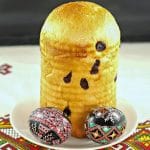
📋 Ukrainian Babka Recipe (Bread Machine)
Although this tender, cakelike Ukrainian Babka, a sweet traditional Ukrainian Easter bread recipe, is made easier by making it in your bread machine, I have preserved all that is wonderrfu! about this Traditional Ukrainian Babka recipe!
Servings 18 servings
Calories 199kcal
Equipment
- 3 large tomato juice (48 oz /1.36 L) or 5- 500 g/l lb coffee tins
Ingredients
- 1 egg
- 3 egg yolks
- 4 tablespoon melted butter
- 3 tablespoon white granulated sugar
- 3 tablespoon powdered milk
- ½ teaspoon salt
- 2 tablespoon orange juice
- 1 tablespoon grated orange zest
- 1 teaspoon vanilla extract
- 1 cup water (*minus 1 tbsp)
- 3 ¾ cup flour * I use all-purpose flour -9% protein
- 1 teaspoon bread maker yeast
- 1 cup raisins
- 3 egg whites
- ¼ cup shortening * I use vegetable shortening but you could use lard.

Instructions
- In a large bowl, beat egg, egg yolks, butter, sugar, salt, milk powder, orange juice, orange zest, vanilla extract and 1 cup of warm water, minus 1 tbsp. *water should be lukewarm1 egg, 3 egg yolks, 4 tbsp melted butter, 3 tbsp white granulated sugar, 3 tbsp powdered milk, 2 tbsp orange juice, 1 tbsp grated orange zest, 1 tsp vanilla extract, 1 cup water (*minus 1 tbsp), ½ tsp salt
- Add flour, then form a small crater with your finger in the top of the flour and pour yeast into this crater. *Do not dig the hole so deep that the liquid comes through; make sure the yeast ONLY touches the flour and not any of the liquid
- Set bread machine on dough cycle. When ‘add fruit/ingredients’ signal goes off, add raisins. *If you don't have a signal, add the raisins after the 2nd knead. Or skip the raisins, if you prefer.1 cup raisins
- Meanwhile, prepare 3 juice tins (I use 48 oz /1.36 L tomato juice tins) by greasing generously with shortening.¼ cup shortening
- When dough cycle is complete, remove bread dough from bread machine. divide dough into 3 balls. Place balls into 3 juice tins and let dough rise until double in bulk (in warm spot). (about 45 mins- 1 hour).
- Beat egg whites until foamy.3 egg whites
- When dough has doubled in bulk, brush the tops of the loaves with egg whites.
- Baking time: Bake in preheated oven on low rack (oven temperature should be 375 degrees F (190 degrees C) ) for 20 – 25 minutes or until golden brown on top *If the tops of the loaves are browning too fast, cover with aluminum foil
- Check for doneness: The old-fashioned way: Remove from oven and knock on the bottom of the tin with your knuckles. If done, it will sound hollow when tapped.The best way: use a thermometer to assess the doneness of breads, freeform loaves, and soft rolls. A temperature of 180- 190°F (82-88°C) at the center will yield bread that's fully baked. I use this instant read thermometer- (affiliate link) -it's great for everything food related!
- Remove baked loaves from oven, cool slightly and remove from tins onto pillows covered with tea towels.
- Slice cooled loaves in rounds with a bread knife or sharp knife, then serve with butter, if desired.
Notes
Pro Tips:
-
- Room Temperature Ingredients – Ensure all wet ingredients (butter, eggs, and orange juice) are at room temperature for even mixing and better yeast activation.
-
- Flour Matters – Canadian all-purpose flour works well due to its higher protein content. If using flour with less than 9 grams of protein, consider using bread flour (11%) for better structure. Lower protein levels can result in less volume and a tighter crumb.
-
- Proper Yeast Placement – Always place the yeast in a small crater on top of the flour (not touching any liquid) to prevent premature activation before the mixing cycle begins.
-
- Use the Right Tins – If you can't find tomato juice tins, use 9X5x2 loaf tins. You will only need 2, and you'll likely need to bake it a little longer.
-
- Controlled Warm Environment for Rising – If your kitchen is cool, let the dough rise in a slightly warm oven (turned off, with the light on) for consistent proofing.
-
- Prevent Overbrowning – If the tops brown too quickly, loosely tent the loaves with aluminum foil for the remainder of the bake time.
-
- Doneness Check – Instead of just knocking on the bottom, use an instant-read thermometer for precision. The internal temperature should be 180- 190°F (82-88°C).
- Cool on Pillows for Shape – To prevent collapsing and dents, cool the babka on pillows covered with clean tea towels, gently rotating them every 10 minutes to maintain a round shape.
Nutrition
Serving: 1slice | Calories: 199kcal | Carbohydrates: 29g | Protein: 5g | Fat: 7g | Saturated Fat: 3g | Trans Fat: 1g | Cholesterol: 50mg | Sodium: 108mg | Potassium: 137mg | Fiber: 1g | Sugar: 3g | Vitamin A: 150IU | Vitamin C: 1mg | Calcium: 24mg | Iron: 2mg
